AI Traffic: Fewer Page Views – but Higher Conversions
AI traffic isn't underperforming. It's evolving. Visitors from AI platforms view fewer pages and bounce faster, yet they convert more often. For marketers who design pages with precise, goal-oriented answers, that shift is pure opportunity.
Kategorije:
Kazalo vsebine
- Why AI Traffic Isn’t the Same as Search Traffic
- Study: Comparing AI Traffic with Traditional Search
- AI Visitors Browse Less but Stay Engaged Longer
- The Truth Behind Higher Bounce Rates in AI Search
- Is Traffic from AI Sources Actually Better Quality?
- Lessons for Marketers in the Age of AI Search
- Using AI-Driven Visitors to Boost Conversions


AI traffic isn’t like traditional search. Fewer pages appear, focus tightens, and user expectations rise.
For marketers, that means rethinking how they create and structure content. The latest research shows what this shift looks like in practice and how to turn it into an advantage.
Let’s see how to adjust content and make the most of new opportunities.
Why AI Traffic Isn’t the Same as Search Traffic
AI traffic isn’t the same as traditional search. Google keeps assuring us that artificial intelligence will make search results better, but marketers and analysts still don’t have clear data to prove it.
Google Search Console doesn’t distinguish between visitors coming from regular search and those landing through new features like Google AI Overviews, which now drive a growing share of AI traffic.
To fill that gap, researchers turned to independent data. They analysed visits from AI platforms including ChatGPT, Perplexity, Copilot, and Gemini.
Drawing on a sample of more than 81,000 websites, they compared the behaviour of three groups:
- Visitors coming from search engines,
- visitors arriving through AI platforms,
- overall traffic across all sources.
The results reveal sharp behavioural differences every digital marketer should pay attention to.
Study: Comparing AI Traffic with Traditional Search
The Ahrefs study, carried out between May and June 2025, analysed more than 81,000 websites from different industries and countries. The size and variety of the sample made it a reliable foundation for comparing how users behave depending on where they come from.
How the Study Divided Website Visitors by Source
To understand the impact of each channel, visits were divided into three main categories:
1. Search traffic
Users arriving through search engines such as Google, Bing, or Yahoo. Special attention was given to Google AI Overviews, which now combine traditional search results with generative responses. As a result, search traffic has become a mix of classic and AI-assisted queries.
2. AI traffic
Users visiting websites via AI platforms like ChatGPT, Perplexity, Copilot, and Gemini. These visitors use AI tools as an alternative to search, preferring faster, conversational access to information.
3. Overall traffic
A reference group including all sources combined: search engines, AI platforms, social media, direct visits, email, paid campaigns, and more. This average served as the baseline for comparing behavioural differences across all traffic types.
Core Metrics: Pages, Sessions, and Bounce Rate
To understand the quality of visits, researchers tracked four key user behaviour metrics.
- Average pages per session show how many pages a visitor views in one visit. A higher number usually indicates stronger curiosity or deeper exploration.
- Average session duration measures how long users stay on a website during one visit. Longer sessions often point to higher engagement.
- Time spent on a page gives a more detailed look at how much attention visitors devote to individual content.
- Bounce rate measures the percentage of visitors who leave after viewing only one page and is often used to gauge relevance.
What Makes the AI Search Traffic Study Groundbreaking
At first, it might seem like another data report, but this study represents a real breakthrough.
For the first time, researchers clearly separated AI search traffic from traditional search, allowing more precise comparisons. It also shows how user journeys are shifting as generative AI becomes a main entry point to information online.
The findings raise an important question about which metrics still accurately reflect visit quality and which will need redefining.
For marketers, it’s a signal to move beyond classic KPIs. It’s no longer enough to track whether traffic is rising or falling. What matters is understanding the intent, context, and quality behind each visit.
Only by integrating these insights into a digital strategy can AI-driven traffic become a measurable opportunity for growth.
Related topic: ‘Protect Your Brand Reputation from AI-Generated Answers’.
AI Visitors Browse Less but Stay Engaged Longer
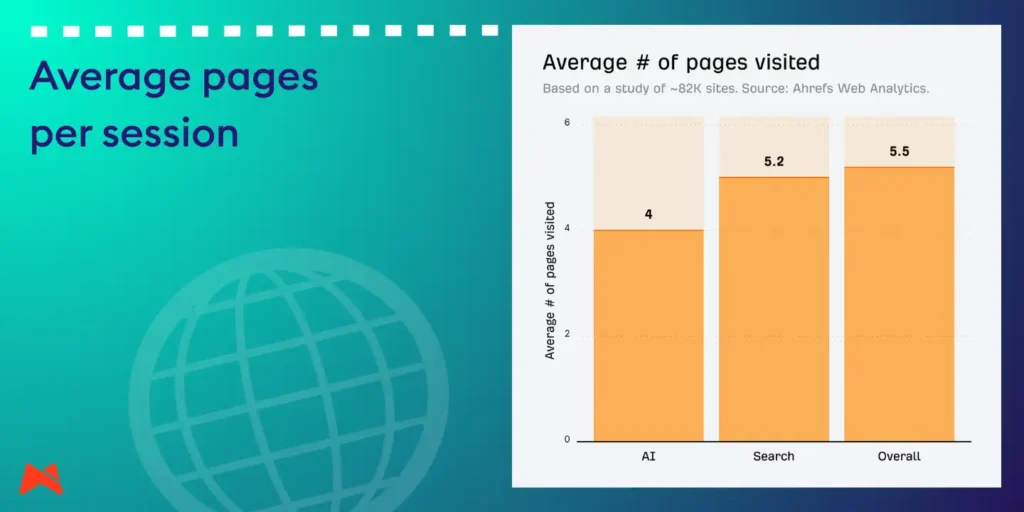
The study shows that visitors from AI traffic view an average of four pages per session, 1.2 fewer than users from search and 1.5 fewer than the overall average.
The difference in browsing depth is even greater. AI visitors explore only 2.27 pages per visit, compared to 2.79 for search users and 2.99 for the average visitor.
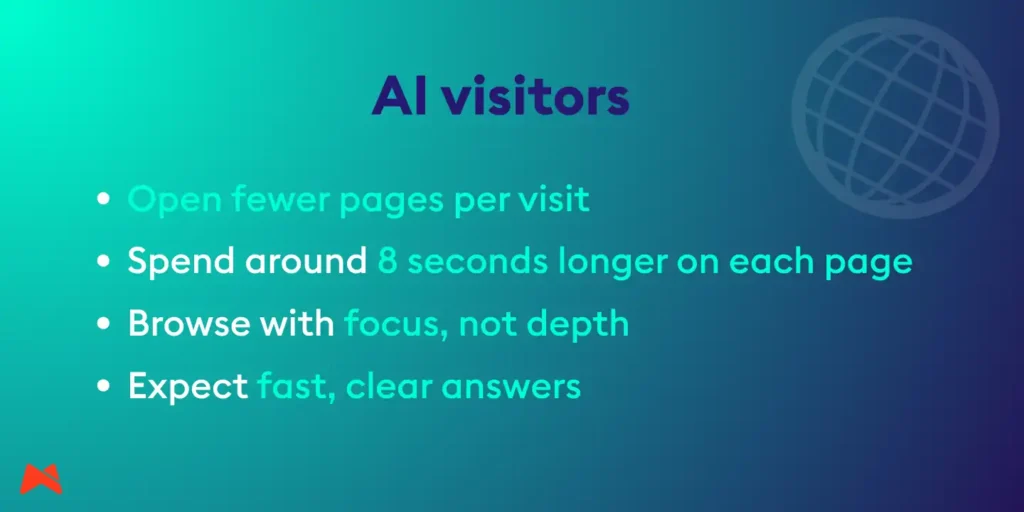
Still, AI users spend roughly eight seconds longer on a website than those coming from traditional search.
Their behaviour suggests fewer clicks but stronger intent. They focus on selected content that directly answers their question.
What These User Trends Mean for Marketers
The trend is unmistakable: visitors coming through AI arrive with a clear purpose. They’ve already refined their search within AI tools, so when they reach your site, they expect quick, specific answers. Their browsing might be shallow, but their focus is sharp.
For marketers, this means every landing page needs precision. Provide direct answers, a clear structure, and the shortest path to conversion.
When users get what they need fast, even a single-page visit can deliver better results.
In AI Overviews, friction for users is lower, so they explore more — and that opens new opportunities for websites, creators, and publishers. It also drives higher-quality clicks. – Elizabeth Reid, Head of Search, Search Engine Land
The Truth Behind Higher Bounce Rates in AI Search
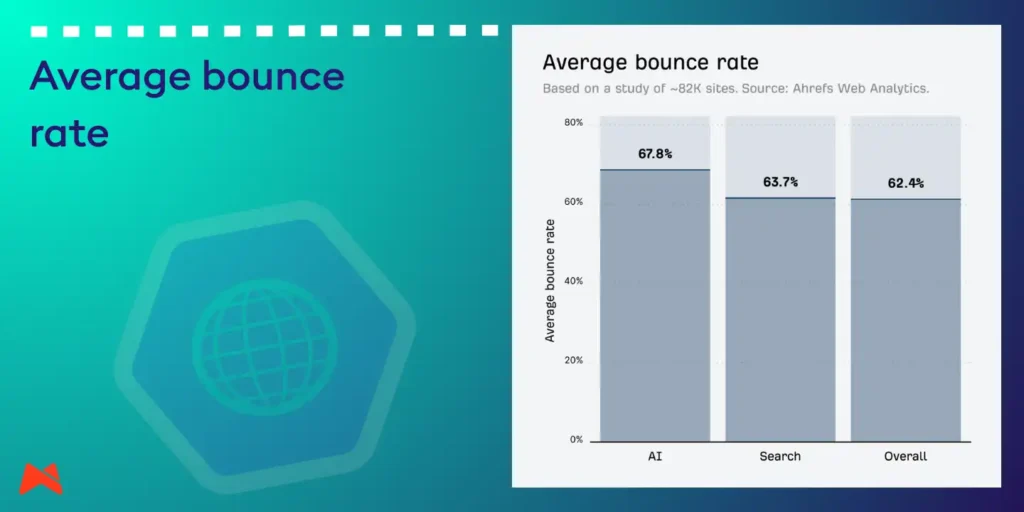
Data shows that visitors coming from AI platforms tend to leave websites more often. Their bounce rate is 4.1% higher than that of users from search engines and 5.4% above the overall average. This confirms that AI users arrive with a specific goal and rarely explore additional pages.
When someone spends about a minute on a page and then leaves, two explanations make sense:
The first is positive: the page delivered exactly what the user was looking for, so there was no reason to continue clicking. The Ahrefs study supports this, revealing that AI visitors convert up to 23 times more often than organic visitors from search. In that case, a higher bounce rate reflects efficiency, not failure.
The second is less flattering: if the content or user experience doesn’t meet expectations, visitors leave quickly. Because AI-driven users know precisely what they want, they lose interest fast when the information is too general or poorly structured.
That’s why optimising for this type of visitor matters. Focused landing pages with clear answers and a simple structure can turn a potential exit into a conversion.
Is Traffic from AI Sources Actually Better Quality?
At first, traffic from AI platforms might look less impressive. Visitors open fewer pages, show higher bounce rates, and often focus on a single goal before leaving. This behaviour is typical of users searching for one specific answer rather than browsing widely.
But when conversions enter the equation, the picture shifts completely. Data shows that AI visitors perform far more valuable actions despite spending less time exploring. Their clicks are highly qualified because they arrive with a clear, well-defined intent. That makes them far more likely to purchase or send an enquiry than users coming from traditional search.
Practical examples confirm it. Vercel reports a 10% conversion rate from AI-driven visitors, while for Tally, AI has become the leading channel for user acquisition — generating an additional one million dollars in yearly revenue.
So, AI traffic might not deliver higher engagement, but it drives stronger, more decisive actions. Fewer pages viewed, more conversions achieved — this channel calls for a different approach than traditional search.
Lessons for Marketers in the Age of AI Search
The research makes it clear: visitors coming through AI platforms don’t behave like typical search users. Their intent is sharper, their expectations higher. For marketers, that means rethinking how content is written, measured, and optimised.
How to Engage Visitors Coming from AI Platforms
Visitors who arrive from AI tools have a clear purpose. They expect quick, reliable information and a direct path to action.
Many visit a site to confirm what they read in ChatGPT or Google AI Overviews. Providing accurate, well-supported information builds trust and sharply increases the chance of conversion.
Rethinking Metrics for AI-Driven User Behaviour
Classic metrics like time on site, bounce rate, or number of page views no longer tell the full story. AI visitors often read one page and leave — but that doesn’t mean poor performance.
The real measure of success now lies in conversions: form submissions, sign-ups, purchases, or enquiries. Only these actions reveal how much value AI-driven visitors actually bring.
Using Focused AI Visitors for Faster Optimisation
AI traffic offers a chance to experiment faster. Because these visitors are more focused, A/B testing landing pages, headlines, or calls to action brings clearer, quicker results. Their consistent behaviour makes it easier to see what truly works.
SEO is also moving in a new direction. Generative search tools like Google SGE and AI Overviews reward content that delivers direct, credible answers. Marketers who adapt early to this shift will find it easier to grow and stay visible as AI search continues to reshape how users discover and trust brands online.
Using AI-Driven Visitors to Boost Conversions
AI search traffic results in fewer page views and higher bounce rates, yet it generates significantly more conversions. It’s not lower quality — it reflects a new way users search, consume, and act on information.
For digital marketers, the message is simple: landing pages must provide clear, fast, and accurate answers. When users instantly find what they need, they’re much more likely to make a purchase or send an enquiry.
If you want to refine your strategy and capture the potential of AI-driven visitors, get in touch — we’ll show you where the real growth opportunities lie.
Inspired by the Ahrefs article ‘AI Visitors Visit Fewer Pages and Bounce More Often Than Traditional Search Visitors’ by Louise Linehan, published June 24, 2025.