Don’t Let Your Ecommerce Website Redesign Kill Your SEO
An ecommerce website redesign can undo years of work in a matter of weeks. One overlooked URL or one deleted category description is enough. This article covers four mistakes that show up in almost every redesign, and what to do so your organic traffic doesn't take the hit.
Kategorije:


Every ecommerce website redesign starts with the same pitch: a cleaner design, a faster site.
Then, a month or two after launch, traffic quietly drops, and by the time anyone notices, it’s already too late to fix.
An analysis of nearly 900 domain migrations found that a new site version needs 523 days on average to match the old one’s organic traffic. 17 percent never get there at all. Full study here.
None of that comes down to a weak platform. It comes down to four classic SEO mistakes, and they show up on every redesign, regardless of who’s running it.
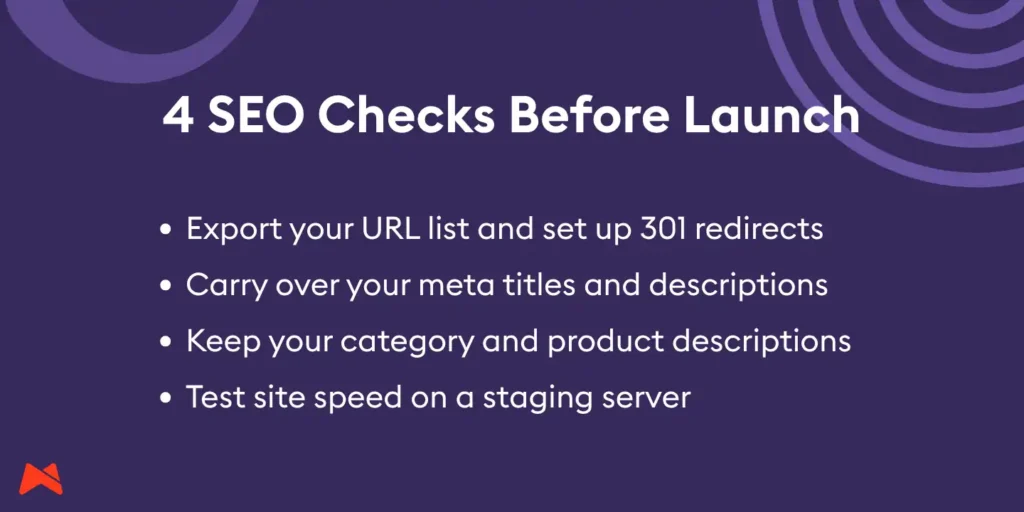
No time to read the whole thing? Four things wreck almost every redesign: redirects, meta data, category content, mobile speed.
Here’s how to dodge every one of them. ↓
Ecommerce Website Redesign and Its 4 Most Common SEO Mistakes
1. Changed URLs Without Redirects
Transferwise’s move to Wise.com dropped monthly organic traffic from 32 million to under 13 million. Not because the new platform was weaker. Because the URL redirects were handled badly. See the migration breakdown.
The same thing happens on a smaller scale in most redesigns. A product URL changes, Google loses the page that used to rank, and the visitor hits a 404 where the product used to be.
And it’s usually the best-performing product pages that get missed, because they feel too obvious to double-check.
Before you touch anything, export the full list of indexed URLs from Google Search Console. For every URL that’s changing, set up a 301 redirect to the most relevant new page. Not the homepage.
2. Meta Titles and Descriptions Overwritten With a Generic Template
Plenty of ecommerce platforms auto-generate new meta titles and descriptions during a migration, all pulled from the same template. If you haven’t audited your meta data yet, our piece on common SEO and GEO optimisation mistakes covers what usually gets missed.
That erases the exact uniqueness that got the page ranked in the first place, and click-through rate in search results drops fast.
The fix is simple, but timing matters.
Export your existing meta data before the migration, map it to the new URLs, and only rewrite what’s actually different on the page.
3. Deleted Category and Product Descriptions
So why keep a long category description at all, if it just makes the page look less ‘clean’?
Because that description is exactly what tells Google what the page is about, and gives the shopper something to trust before they buy.
Don’t delete it. Move it. Drop it further down the page, or hide it behind an expandable element. It stays in the code, out of the way, and the layout stays intact.
4. A Slower Mobile Experience
Mobile already drives most ecommerce traffic. Traffic benchmarks from Triple Whale confirm it. Every extra second of load time after an ecommerce website redesign doesn’t just cost you rankings. It costs you sales.
A redesigned store most often gets slowed down by:
- oversized, uncompressed images
- leftover code from the old design that nobody bothered to clean up
- missing cache
- bulky CSS and JS files that load before any content shows up
Before you hit publish, load the site on a staging server and check it on a real phone. Your office monitor doesn’t count.
Thinking about redesigning your store, or building a new one? Here’s where to start → E-commerce Development.
How to Prevent Traffic Loss During an Ecommerce Redesign
All four mistakes trace back to the same thing. Nobody mapped out which pages, URLs and content needed to survive or redirect before the redesign even started.
The single most useful tool here is a plain spreadsheet. For every old URL, note which new page it redirects to. That spreadsheet often decides whether traffic comes back in a few weeks or takes almost two years, per the migration research above.
Ecommerce Website Redesign That Drives Growth, Not a Drop
None of these four mistakes are hard to fix if you catch them early. The trouble starts only when nobody’s paying attention.
At Madwise, we stay on every website redesign from the first analysis through to launch, so the new store keeps what the old one already built, and builds on it.
Don’t let your new store launch already losing traffic. Email us at hello@madwise.si and we’ll check whether your plan is SEO-ready before you go live.